Best WordPress Speed Plugins: Free and Paid Picks Compared
The best WordPress speed plugin for most sites is a free page cache: WP Fastest Cache if you want the simplest setup, or LiteSpeed Cache if your host runs a LiteSpeed web server. If you would rather pay for a plugin that switches most speed settings on for you, choose WP Rocket, and add Autoptimize or Perfmatters only if you need more control over CSS and JavaScript.
Speed plugins do three different jobs: page caching, asset optimisation (minifying and deferring CSS and JavaScript, lazy loading images) and database cleanup. Many plugins now do all three, so pick one main plugin and add a second only for a job the first does not cover.
Which WordPress speed plugin should you choose?
- Simplest free page cache: WP Fastest Cache.
- Your host uses LiteSpeed or OpenLiteSpeed: LiteSpeed Cache.
- A plain, low-maintenance cache from the makers of WordPress.com: WP Super Cache.
- Developers who want object cache, database cache and fine control: W3 Total Cache.
- Cache, image compression and database cleanup in one free plugin: WP-Optimize.
- Paying to have most settings handled for you: WP Rocket.
- Optimising CSS and JavaScript on top of a page cache: Autoptimize.
- Turning off scripts you do not use, page by page: Perfmatters.
What is the difference between caching, asset optimisation and database cleanup?
Page caching saves each page as a static HTML file. The next visitor gets that file instead of WordPress running PHP and database queries again, which lowers server load and makes the first byte arrive sooner. This is the biggest single gain on most sites.
Asset optimisation works on what the browser downloads: minifying and combining CSS and JavaScript, deferring scripts that are not needed straight away, generating critical CSS and lazy loading images. These settings help scores in PageSpeed Insights, but they are also the ones most likely to break a layout, so turn them on one at a time.
Database cleanup removes old revisions, auto drafts, spam comments and expired transients. It keeps the database small.
How do the speed plugins compare?
| Plugin | Main job | Price | Active installs | Tested up to |
|---|---|---|---|---|
| WP Fastest Cache | Page cache, minify, combine | Free, paid Premium | 1 million+ | WordPress 7.1.4 |
| LiteSpeed Cache | Server-level page cache, full optimisation | Free (cache needs a LiteSpeed server) | 7 million+ | WordPress 7.1.4 |
| WP Super Cache | Page cache | Free | 1 million+ | WordPress 7.1.4 |
| W3 Total Cache | Page, object and browser cache, minify | Free, paid Pro | 900,000+ | WordPress 7.1.4 |
| WP-Optimize | Page cache, images, database, minify | Free, paid Premium | 1 million+ | WordPress 7.1.4 |
| WP Rocket | Page cache, preload, file and media optimisation | Paid only, 14-day free trial | Not on wordpress.org | Not listed |
| Autoptimize | CSS, JavaScript and HTML optimisation | Free, paid Pro | 800,000+ | WordPress 7.1.4 |
| Perfmatters | Script manager, small tweaks, database | Paid only, from $24.95 a year | Not on wordpress.org | Not listed |
One thing we checked ourselves: in the wordpress.org plugin directory, LiteSpeed Cache lists 7 million+ active installs, seven times the 1 million+ shown for WP Fastest Cache, WP Super Cache and WP-Optimize, and all six free plugins in this table are marked as tested with WordPress 7.1.4. A high install count is still not a reason to use LiteSpeed Cache on a host that runs Apache or NGINX, where its page cache does not work.
1. WP Fastest Cache
Best for: beginners on shared hosting who want caching working in a few clicks.
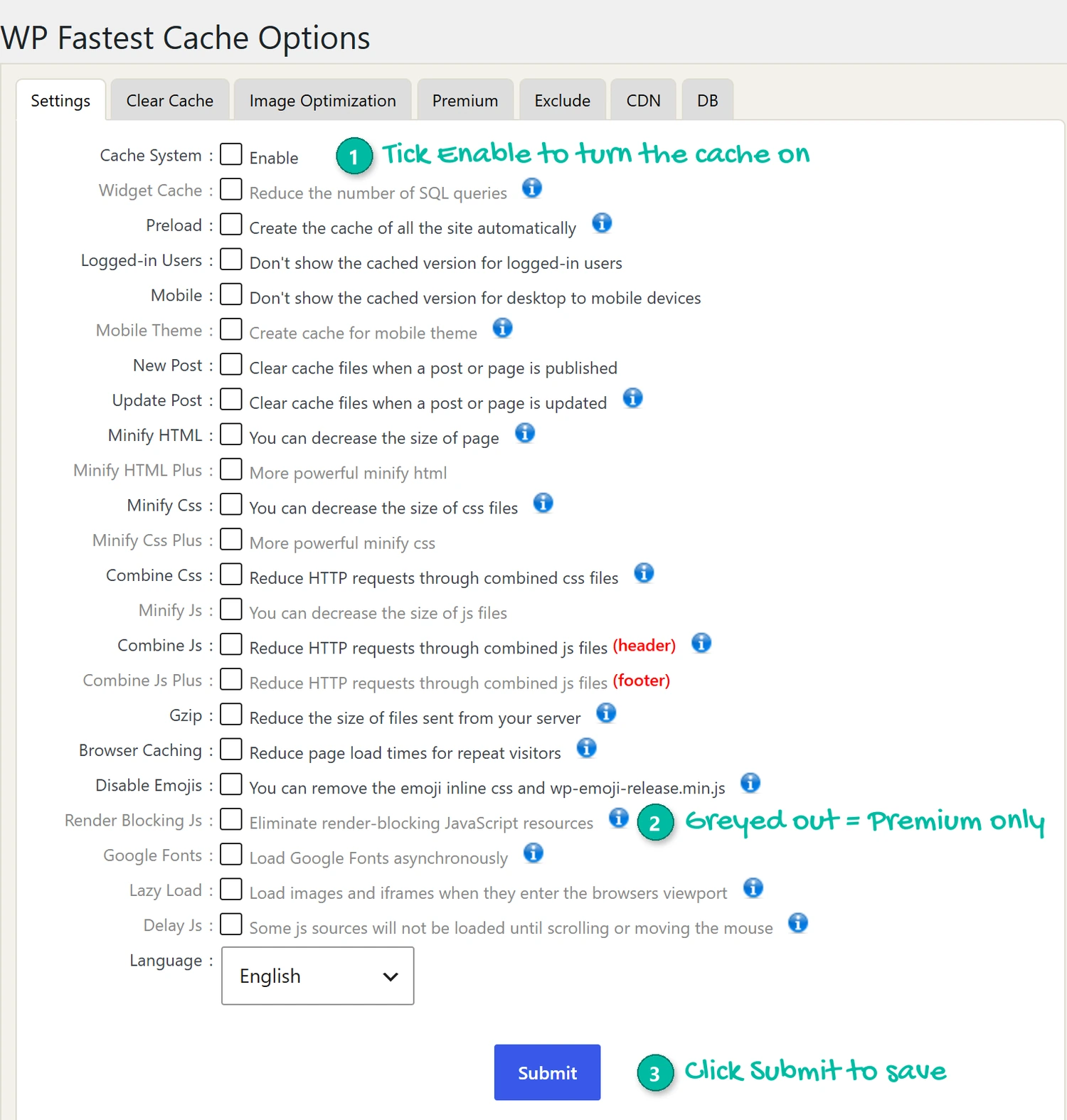
WP Fastest Cache creates static HTML files from your pages and serves them through Apache's mod_rewrite, so PHP does not run for cached visits. It clears the cache when you publish a post or page, and lets you set a cache timeout, block caching on one page with a shortcode, and choose whether to cache for mobile devices and logged-in users. The free version also minifies HTML and CSS, combines CSS and JavaScript, enables Gzip compression and browser caching, preloads the cache, and connects to CDNs such as Bunny CDN and Cloudflare. Premium adds JavaScript minify, delayed JavaScript, image optimisation, WebP conversion, lazy load and database cleanup. It has 1 million+ active installs.
2. LiteSpeed Cache
Best for: sites hosted on LiteSpeed, OpenLiteSpeed or a LiteSpeed-powered host.
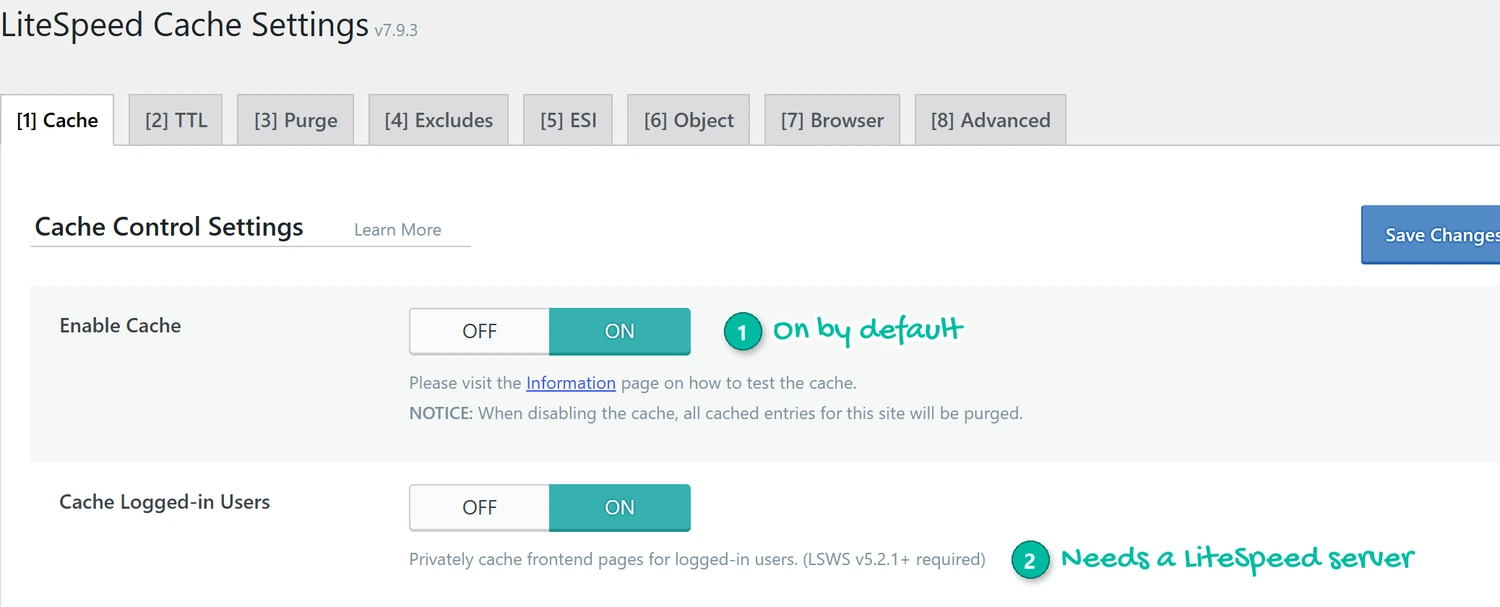
LiteSpeed Cache is free and open source, made by LiteSpeed Technologies, and has 7 million+ active installs. Its page cache runs inside the web server, but that part only works on OpenLiteSpeed, commercial LiteSpeed products, LiteSpeed hosting or the QUIC.cloud CDN. On those servers it adds automatic purging of related pages, a private cache for logged-in users and a crawler that preloads pages from your sitemap. Its general features work on any server, including Apache and NGINX: CSS and JavaScript minify, critical CSS, deferred JavaScript, lazy loading, image optimisation and a database cleaner. Some QUIC.cloud services it connects to, such as image optimisation and critical CSS, can require payment. If you run your own server, our guide to installing WordPress on OpenLiteSpeed gets you the full cache.
3. WP Super Cache
Best for: blogs that want a simple, stable page cache and nothing else.
WP Super Cache is made by Automattic, the company behind WordPress.com, and has 1 million+ active installs. It generates static HTML files and serves them to visitors who are not logged in and have not left a comment. Its Simple mode, which the developers recommend, serves cached files through PHP without editing .htaccess; Expert mode bypasses PHP using mod_rewrite. It also has CDN support and a preload mode. It does no minifying, so pair it with Autoptimize if you want that.
4. W3 Total Cache
Best for: developers and busy sites that want object caching and full control.
W3 Total Cache, by BoldGrid, has 900,000+ active installs. It covers page cache, object cache, database cache, browser cache, minify, lazy load and CDN integration, and a Setup Guide wizard runs the first time you open it. The developer recommends Disk Enhanced page caching for most sites and leaving database cache off on shared hosting. W3 Total Cache Pro adds Full Site Delivery, fragment cache and REST API caching. It has more settings than any other plugin here, so follow our recommended W3 Total Cache settings rather than turning everything on.
5. WP-Optimize
Best for: site owners who want caching, image compression and database cleanup from one free plugin.
WP-Optimize, by David Anderson and Team Updraft, has 1 million+ active installs. It does four things: page caching with preloading and Gzip compression, lossy or lossless image compression with WebP conversion, database cleanup, and CSS and JavaScript minification. You can also serve separate cache files to mobile devices. Premium adds lazy load, scheduled cleanups and multisite support. Its cache can be switched off, so you can keep using its image and database tools alongside another cache plugin.
6. WP Rocket
Best for: site owners who would rather pay than tune settings.
WP Rocket is a paid plugin sold on its own website, not on wordpress.org, and its public changelog shows regular releases. On activation it turns on page caching, cache preloading, browser caching and Gzip compression, and it keeps sensitive ecommerce pages out of the cache. Its settings are split into cache, file optimisation, media, preloading, database, CDN and add-ons, and it includes a free performance dashboard called Rocket Insights. Licences are billed yearly per number of websites, with a 14-day free trial; see the WP Rocket pricing page for current prices, and check whether the first-year price differs from the renewal price.
7. Autoptimize
Best for: adding CSS and JavaScript optimisation to a plain page cache such as WP Super Cache.
Autoptimize, by Optimizing Matters, has 800,000+ active installs. It does not cache pages. Instead it aggregates and minifies scripts and styles, can inline critical CSS and defer the rest, defers scripts, minifies HTML, lazy loads images and optimises Google Fonts. Its own documentation suggests pairing it with a page cache plugin. Autoptimize Pro is a paid add-on with page caching, image optimisation, a CDN and automatic critical CSS. Do not turn on the same minify settings in Autoptimize and in your cache plugin.
8. Perfmatters
Best for: removing scripts and features your site loads but does not use.
Perfmatters is a paid plugin sold on its own site. Its main tool is a Script Manager that disables scripts and styles on the pages where they are not needed, plus one-click toggles to disable emojis, embeds, XML-RPC and WooCommerce cart fragments, limit post revisions and slow down the Heartbeat API. It also has delay JavaScript, remove unused CSS, lazy loading and database cleanup. Recent versions added a page cache tab marked beta. Prices listed on its pricing page are $24.95 a year for one site, $59.95 for three sites and $124.95 for unlimited sites, with a 30-day money-back guarantee.
Why should you run only one page cache plugin at a time?
WordPress loads page caching plugins through a single drop-in file, wp-content/advanced-cache.php. A comment in WordPress's own wp-settings.php explains that it uses one fixed file "because you would only want one". Two page cache plugins end up fighting over that file and over the rules they write to .htaccess, so one of them stops working or the site behaves unpredictably. The WP-Optimize FAQ says it directly: its page cache cannot run with another cache plugin, because both would need advanced-cache.php. The W3 Total Cache install steps also start with deactivating and uninstalling any other caching plugin.
What you can combine safely is one page cache plus a plugin that does a different job, such as WP Super Cache with Autoptimize, or LiteSpeed Cache with WP-Optimize's cache turned off. Just make sure only one plugin handles each task, because two plugins that both defer JavaScript or minify CSS can break your layout. Some hosts make their own speed plugin, such as SiteGround's Speed Optimizer and Cloudways' Breeze. If your host recommends one, start with that before adding another. If the site is still slow with caching on, the problem is often heavy plugins or background tasks; our guide to reducing high resource usage in WordPress covers how to find them.
How do you check whether a speed plugin worked?
- Before installing anything, open PageSpeed Insights, enter your home page and one typical post, and note the mobile results.
- Install one plugin, turn on its page cache, then visit the site in a private browser window so the cache is built for logged-out visitors.
- Test the same pages again. Look at the Lab data (from Lighthouse, a simulated load) to see the immediate change.
- Turn on asset options such as minify or defer JavaScript one at a time, checking your pages after each.
- Check the field data a few weeks later. It comes from real Chrome users over the previous 28 days, so it updates slowly and only appears once a page has enough visits.
Google's Core Web Vitals guidance counts a page as good when Largest Contentful Paint is within 2.5 seconds, Interaction to Next Paint is 200 milliseconds or less, and Cumulative Layout Shift is 0.1 or less, measured at the 75th percentile of visits.
FAQ
Is WP Fastest Cache or LiteSpeed Cache better?
It depends on your server. On LiteSpeed or OpenLiteSpeed hosting, LiteSpeed Cache is the better choice because its cache runs in the server itself. On Apache or NGINX hosting, LiteSpeed Cache cannot cache pages without QUIC.cloud, so WP Fastest Cache is simpler. Ask your host which web server you are on, or check your hosting control panel.
Is WP Rocket worth paying for over a free plugin?
WP Rocket's main advantage is that it turns most settings on for you and comes with support. If you are comfortable testing a few options in WP Fastest Cache or W3 Total Cache, a free plugin is enough. Try the 14-day trial if you want to compare on your own site.
What is the best free WordPress speed plugin?
For most sites, WP Fastest Cache or WP Super Cache for the page cache, plus Autoptimize if you need CSS and JavaScript optimisation. On LiteSpeed hosting, LiteSpeed Cache alone covers both.
Can a speed plugin get my PageSpeed score to 100?
Not on its own. Large images, heavy themes and third-party scripts such as ads and chat widgets also limit the score. A cache plugin fixes server response time; the rest comes from lighter pages.

Related Articles

3 Best Free WordPress Plugins to Set Preloader on WordPress Site

3 Best WordPress Copy/Paste Protecting Plugins (To prevent your content from being stolen)

How to Speed Up WordPress With a Plugin
